Showing posts with label japan. Show all posts

16 April 2015

Japan Day 7: YOSHINOYAMA

We woke up heavily (the previous day was fun yet tiring) but we couldn't snooze our alarm. Get up, get up! Our next itinerary was Yoshinoyama (not the food-chain Yoshinoya, okay)! We met our friends at Kyoto Station, had breakfast, then bought our tickets to Yoshino Station using Kintetsu Railway which costs about JPY 1,200 one way. The trip took about 2 hours (including one transit at Kashihara-jingu-mae Station), a chance to continue our sleep!
 
We arrived at Yoshino Station at about 12 PM, time to eat! The weather was soooo cold  (about 4 deg Celcius) for us the equator kids! We first had to climb (exaggerated, of course) a rock stair. Thank God there was a cozy cafe there who also sold food. Hot drink and hot food were exactly what I needed!
Almost there, ganbatte!


I love wooden ceiling!
After we finished our meal (and used the toilet), we started our hike! *patting tummy* Let's take a walk, kiddo!

Yoshinoyama is divided into four areas: the Shimo Senbon (lower 1000 trees) at the base of the mountain, Naka Senbon (middle 1000 trees), Kami Senbon (upper 1000 trees) and Oku Senbon (inner 1000 trees) at the top of the mountain. But it was said that nowadays Yoshinoyama has about 30,000 sakura trees. It was famous as the best place to do hanami (contemplation of cherry blossoms) in Japan. Due to difference of altitude and temperature, sakura in lower senbon will bloom first, followed by sakuras in the next senbon after 2-3 days and gradually sakura trees at next senbons bloom too. Our visit at the beginning of April was kinda a wrong timing, since the cold weather prevented the sakura buds to bloom. Only several trees had started to bloom. We had already known it from observing sakura guides in several sites, nonetheless, we still decided to give it a try since the mountain looks like a beautiful place. And we weren't disappointed!
Here is a route map from Japan Guide
Map of Cherry blossoms, autumn leaves and hydrangea
Keep this map from Mount Yoshino official website; the map there are all in Japanese
During the cherry blossom season from late March to early May (March 28 to May 6, 2015), shuttle buses operate between Yoshino Station and the Naka Senbon area. The buses depart 2-4 times per hour and cost 360 yen one way. From the Naka Senbon area near Chikurin-in Temple, mini buses operate further to the Oku Senbon area of Yoshinoyama (15 minutes, 400 yen one way, 1-2 buses/hour). We decided to take the bus from Yoshino station to naka-senbon, then continue our hike to kami-senbon.
Hubby's big blunder : only wearing thin shirt and cardigan! Don't try this, okay!
The view when we started our journey
 

Sakura, sakura, sakura!
Loooove the sky and sakura trees' silhouette!
Most sakura buds hadn't bloomed yet. Like I said, kinda bad timing!

yoshinoyama-sakura
Here is how it looks like during mankai (pic from kanpai-japan.com)


Thank God we already saw ume blossoms at Yoshino Baigo. Looking at the pics, it looks similar with sakura blossoms in Yoshinoyama.

When we reached kami-senbon, the sky was getting darker and cloudier. I had gotten very tired, too. We headed back down using different road from the one we used by bus. There were several small native kids (around 5 years old) with their moms (carrying their babies) hopping easily while we cautiously put our step on the ground. Aaaww embarrassing! 

It's a shame we didn't take any pic of the stores in shimo-senbon area because of the rain.Those cute shops and cafes sells sakura snacks (mochi, cakes, ice cream) and kuzu (arrow root) snacks. However, the prices were quite expensive (perhaps to pay for the view).

Next time when we go here again, I'd like to bring picnic basket and a blanket when sakura trees reach mankai (about mid-April) or autumn.

We got back to Yoshino station, where I bought a cute umbrella with sakura patterns. The one displayed in front of the shop (wet from the rain drops) was black but I chose a pink one. However when I opened it, there was no sakura pattern there! I complained (asked nicely) to the seller, and the lady gleefully said 'ah!' and nicely showed us one of her dry folded umbrella, opened it, showered it using her watering jar, and voila! The sakura patterns showed up! We said 'wooww' in unison. LOL. Now I still regretted 'why didn't I buy more umbrellas?' hihihi... I worried too much about airlines rules about umbrellas.

Hubby and friends kept observing train schedule using Hyperdia. When we arrived at Kahihara-jingu-mae Station, we had to run to other platform for transit because the train to Kyoto will arrive in 3 minutes while the next train wouldn't be there for the next 40 minutes. We didn't want to wait that long in a far-off station! Thank you little baby for being so strong! *patting my tummy again sambil mendelik sama suamik yang bisa-bisanya ngajak bini bunting lari-lari*

We arrived at Kyoto Station and walked around. IMO, looked from outside, Kyoto Station is more modern-looking and futuristic than Tokyo Station but Tokyo's feels more business-like inside. I didn't have much time to explore Tokyo Station but I really like Kyoto's. It is absolutely huge, has skyway and observation deck (however chilly it is, I'm find cause it's free hehehe), has connection to some famous department store (not that I care, actually), and most importantly: has many nice restaurants in it! There were three main food areas in the station (as far as I know): Kyoto Station Ramen Koji (aka Ramen Alley) with its eight ramen restaurants, The Cube Food Court and Isetan's Eat Paradise at 11th floor. Eat Paradise seemed a bit pricey to me.

That night we tried a ramen restaurant (sooo sorry that I forgot the name). The ramen was warm, rich, and delicious. It gave me enough strength to accompany hubby looking around BIC Camera near the station (again, to look for a wristwatch). He was a bit hesitating. We decided to get back home and (kalau dapet ilham) he could buy the watch in the morning before we headed to Osaka. The most nice-polite-helpful store keeper gladly offered to keep the watch for my hubby. Thank you so much, kind ojiisan!

We got home and packed our luggage. Our trip in Japan was almost over, hiiks!

15 April 2015

Japan Day 6: KYOTO part 2B (Kiyomizudera and Hirano Jinja)

When our bus arrived at Kiyomizumichi bus stop, it was already afternoon (about 16.30). I had a good nap during the bus trip hehe... Too bad, we had to walk uphill for about 15 minutes to the temple and I wanted to pee... Arggh! (We heard that we could take another bus uphill but the traffic was very bad; so bad that walking was faster than any vehicles.) When we found the public restroom, it was so crowded with Chinese tourists. You know what happened when Chinese tourists flooded a restroom. Yep. One of most disgusting place in earth. Urrggh...

Never mind, I decided to delete the scene from my memory. We headed to the temple, but wait! Why the entry was closed? We saw some tourists from inside the temple were ushered out while some that wanted to get in were rejected politely (there were some adamant tourists trying to trespass so they got a harsher warning). It turned out that during sakura season, the temple would be illuminated so the temple was closed earlier to be reopened later at 6 PM (we asked an officer in mixed-Japanese-and-wild-guesses-languages). The ticket at noon costs JPY 300 (like usual) and JPY 400 at night. The temple usually closed at 6 PM, but in illumination period (3 times a year at spring, summer, and autumn) it's closed later. 

We shopped for some souvenirs while we waited for about an hour then joined the queue. At exactly 6 PM, the entrance was opened. We bought tickets (honestly, the officers wouldn't know if we didn't buy one; it was so crowded!) and got in.
After shopped for souvenirs, we waited at the stair and took some pics of surrounded area
The map from Kiyomizudera official website

The place was huuuuge! Kiyomizudera was initially built in 8th century and burnt down several times. Current buildings were built during the reign of third Tokugawa shogun, Iemitsu (what a cool person, he rebuilt many of Kyoto's heritage sites). Its name literally means pure water temple; derived from the waterfall on the site which was named Otowa waterfall. Its water is divided to three streams and people could drink from them. It was said that each stream could give long life, success in study, and fortunate love life, separately. However, people were discouraged from drinking water from all three streams. Kemaruk amat cyiiin? We didn't drink from it though. What for? We already finished our study, found the love of our lives (and were expecting a baby from it), and longevity only came from God. *tsaaahhh*
People drinking pure water from Otowa waterfall

Kiyomizudera also most widely known from its large wooden stage which juts out of the main hall (Hondo). There was not a single nail used to make the whole structure! Crazy, huh! It stands 13 meter above the hillside and provides good view to sakura and maple trees below and city view in the distance.
From wikipedia: 
The popular expression "to jump off the stage at Kiyomizu" is the Japanese equivalent of the English expression "to take the plunge". This refers to an Edo period tradition that held that, if one were to survive a 13m jump from the stage, one's wish would be granted. Two hundred thirty-four jumps were recorded in the Edo period and, of those, 85.4% survived. The practice is now prohibited.

Like I said, crazyyyy! (In a good and funny way)

The view of Hondo and its wooden stage. Don't be fooled, it was very crowded!


It was a shame that many buildings were in reconstruction; it didn't affect our visit much but kinda ruined the atmosphere *halah*. We followed the path with the crowds, took some pics, enjoyed the illuminated sakura. We couldn't see the buildings very clearly because of the dusk (most of the buildings only had minimum lighting; I think it's because they usually already closed at 6 PM). In overall, the temple was quite nice but not my fave place to be since I was a bit agoraphobic during my pregnancy. I saw Kiyomizudera a lot in mangas and doramas; I should have known that it wasn't that serene in reality, LOL. The illumination was beautiful, though.


When we got out of the temple, it was already 19.00 and we were hungry. Most of the shops at the road to Kiyomizudera was already closed. We entered one restaurant that was still open. The waitress, as usual, was very kind although she had to try hard just to ask us if we wanted hot or cold drink hahaha... The food was not good, we didn't even keep its pics.

We hopped on a bus to go home but on the way there I asked my hubby to drop by at Hirano Shrine near our rented house. Previous days we passed by and saw that the shrine was holding a sakura matsuri and I was very interested. I knew there wouldn't be any chance to go there since we would go to Yoshinoyama at the next day. We arrived at Hirano shrine at 21.00. Thankfully the shrine was still opened!

Sakura garden with pretty lanterns
Ada yang nampang
 
Food stalls
Food stalls and people picnicking
We had fun getting around the shrine with its illuminated sakura garden and joyous festival. The stalls sold many interesting food and snacks like yakitori, large (really large!) sugar-coated strawberries, and even yakiniku and shabu-shabu! The people were being festive in a polite manner; nobody got drunk and shouted or even talk too loud. Now I know how a Japanese festival feels; so much fun! I don't know what time the shrine was closed. When we left, there were still so many people there!

That ended our trip in Kyoto. As I mentioned earlier, we went to Yoshinoyama at the next day. Having had a tiring day, we went to bed ASAP.


PS:
Next time going to Kyoto, my to-do list is:
1. Amanohashidate's sandbar (one of Japan's 3 Most Scenic View).
2. See illuminated Randen sakura tunnel and kimono forest at night.
3. Imperial Palace, Heian Jingu, Nijo Castle.
4. Hanami at nakaragi no michi along Kamogawa and Yoshinoyama (during mankai / full blossoms) and shirakawa canal at Gion.
5. Trying more of their food! Eg: Kaniryouri FuguRyouri Kameya Nishiten (yep I really really wanna try puffer fish).
6. Nara.  
7. Perhaps Sanjusangendo and Kozenji, if there's enough time.

14 April 2015

Japan Day 6: KYOTO part 2A (Arashiyama and Philosopher's Path)

We woke up quite early, activated our first wifi connection to Kyoto City free wifi, bought our breakfast at nearest Lawson (to be eaten later), and used our One-Day-Pass Bus Card to go to Kitanohakubaicho Station (a Keifuku / Randen line station). We passed our card to a machine in the bus when we took off, then the machine will print the date on card's blank space. Next time we used it, we only had to show the card to the bus driver. Using a Randen train, we went to Arashiyama Station (transit once at Katabira no tsuji Station). In this Japan Guide link, you can find major information about Arashiyama and how-to-get-there.

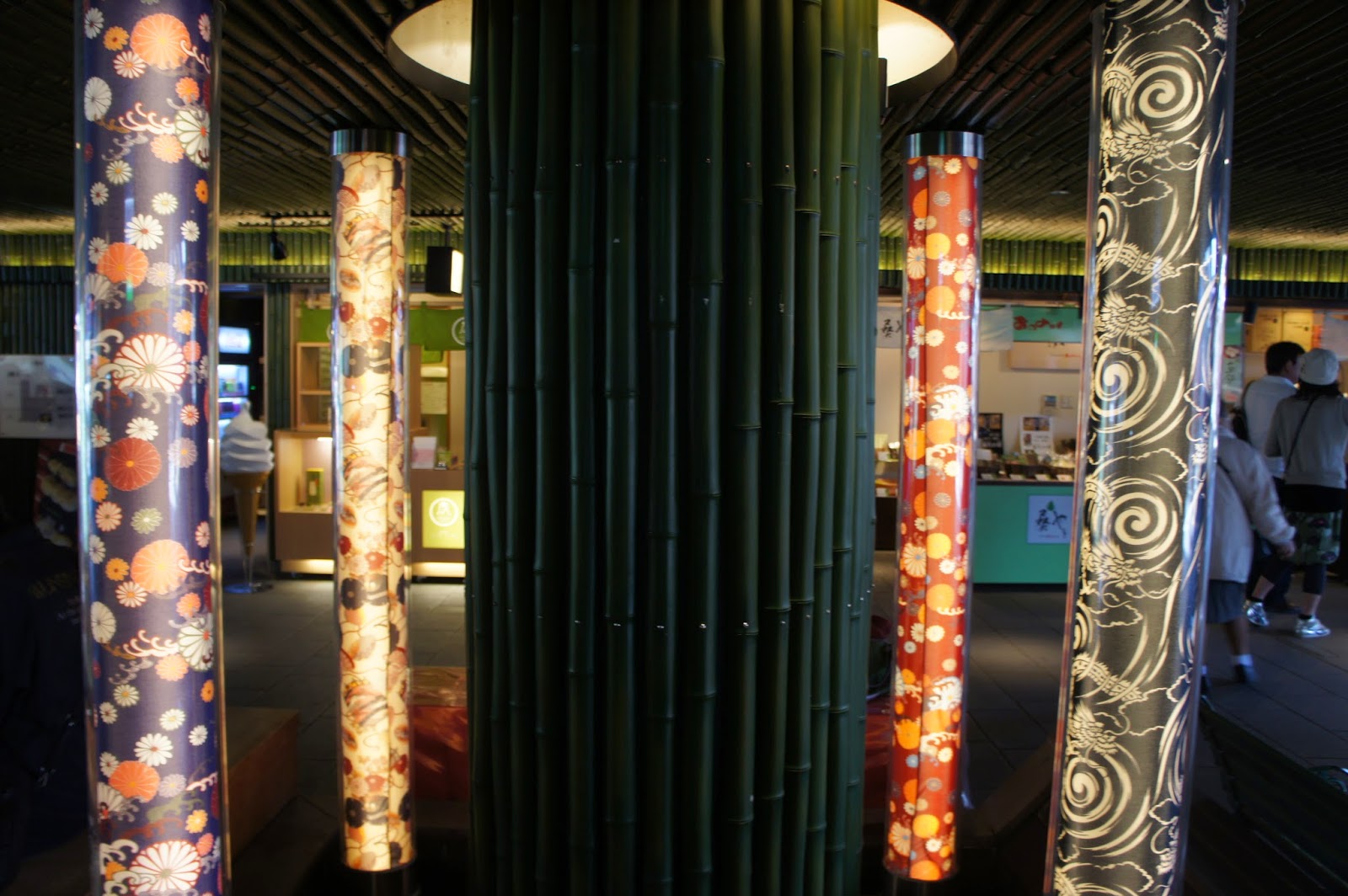
What I anticipated so much to see was obviously riding the Randen tram and seeing the sakura tunnel between Utano and Narutaki Stations (prepare your cam, lads!). Here you can read a lot about Randen, a romantic way to do sight-seeing in northern Kyoto and Arashiyama. When we took off at Arashiyama Station, some Yuzen pillar shape already waited. Next time I'd like to go there at night to see illuminated Kimono Forest with its beautiful kimono patterned pillars. The sakura tunnel is also illuminated during 1st and 2nd weeks of April! This blog provides more beautiful pics.

 
They look like beautiful giant tumblers!

map
Here is an Arashiyama map from Hankyu.co.jp. We took our own path, though.
We arrived at Arashiyama Randen Station. First of all, of course, we went to the Bamboo Forest aka Bamboo Groove. Peaceful, even with so many travelers around us. There was a couple taking wedding pics on a rickshaw, so cute!

We ate our breakfast at the end ot the bamboo path then walking around Kameyama Park. The spring blossoms there was sooo beautiful!
A nice Japanese lady took a pic for us; she was an avid traveler and loved Bali so much!


From Kameyama park, we continued our walk along Oi (Katsura) River toward Togetsukyo Bridge. We watched some boats riding along the river with their guides shouting funnily in Japanese. The river was clean, I was so envious with Japanese people's cleanliness.


Togetsukyo Bridge
When we approached the bridge, the road was more crowded. There were two pretty maiko walked in front of us. Poor girls, they were surrounded by people who tried to take pictures with them and shoved their cameras in front of those girls' faces. We didn't take any pic of them.
After crossed the bridge, we arrived at Nakanoshima Park (aka Arashiyama Park). Many people were already there, picnicking under sakura trees. We bought a macha ice cream and enjoyed the view before we looked for lunch. At the road near the park, there were several restaurants.

People picnicking at Nakanoshima Park
Blue sky and sakura blossoms. Blissful!

Traveling during pregnancy was a bit troublesome aka riweuh. I got hungry all the time but my appetite always dropped when I smell something too flavorful like onion and garlic (which were my fave seasonings before pregnancy came). I also didn't fancy red meat (I could only ate fish, chicken, and pork) and spicy foods because of heartburn. Another factor was the price, LOL. I didn't want to spend too much money on common culinary *tsaaahh*. Thank God we found a resto with affordable prices (around JPY 1,000 per pax) and quite good taste.


We ended our journey in Arashiyama (yep, decided that we didn't have to see the temples etc) and hopped on a bus to Philosopher's Path. We took off at the Ginkakuji bus station and followed the crowd. It wasn't hard to find the path, we could saw its sakura trees not far from the bus stop (we only had to cross the street once).


There were several cafes and food truck and stalls along the way. We bought some post cards from a street artist; his paintings depicting the views of Tetsugaku no michi were very beautiful. We already agreed that we didn't have to finish the path, since it was approximately 2 km long and I usually got tired easily. But hey! The path was too gorgeous and very enjoyable that we finished it unknowingly! *proud* My only regret was that we didn't take plenty enough water. There weren't many vending machines on the path (and most of them were sold out).

We continued our journey to Kiyomizudera by bus (there was a bus stop near Nanzenji).

to be continued to the next part

08 April 2015

Japan Day 5: KYOTO part 1 (Kinkakuji, Ninnaji, Fushimi Inari Taisha)

Itinerary: Kinkakuji and Ninnaji Temple
               Fushimi Inari Taisha
               Dinner at Gion

It was officially our first day in Kyoto (since we spent the previous afternoon and night only to rest). In the morning we hurried to take a bath (soooo cold!) and went to Kinkakuji Temple. Just 15 minutes walk from our rented room! Oops, before we went out, we used our rented room's wifi to request for free Kyoto wifi by sending a blank e-mail to guest@inf-kyoto-city.info, then they sent us Guest Code to be used. Here you can find several ways to get free wifi in Kyoto. Funny that we couldn't connect without Guest Code and we need access to internet (to send and receive it by e-mail). Guest Code is also only valid for 3 hours so we used every e-mail address we had! The signal was only good in several spot too so we had to turn off the connection when not used (to safe batteries)

Entrance fee to Kinkakuji was JPY 400. Here is the link to Japan Guide info about the temple. We got there at around 9 AM and there were already many tourists queuing! We had to try hard to get photos of Kinkakuji without obstruction from other pic-taking tourists hehehe.

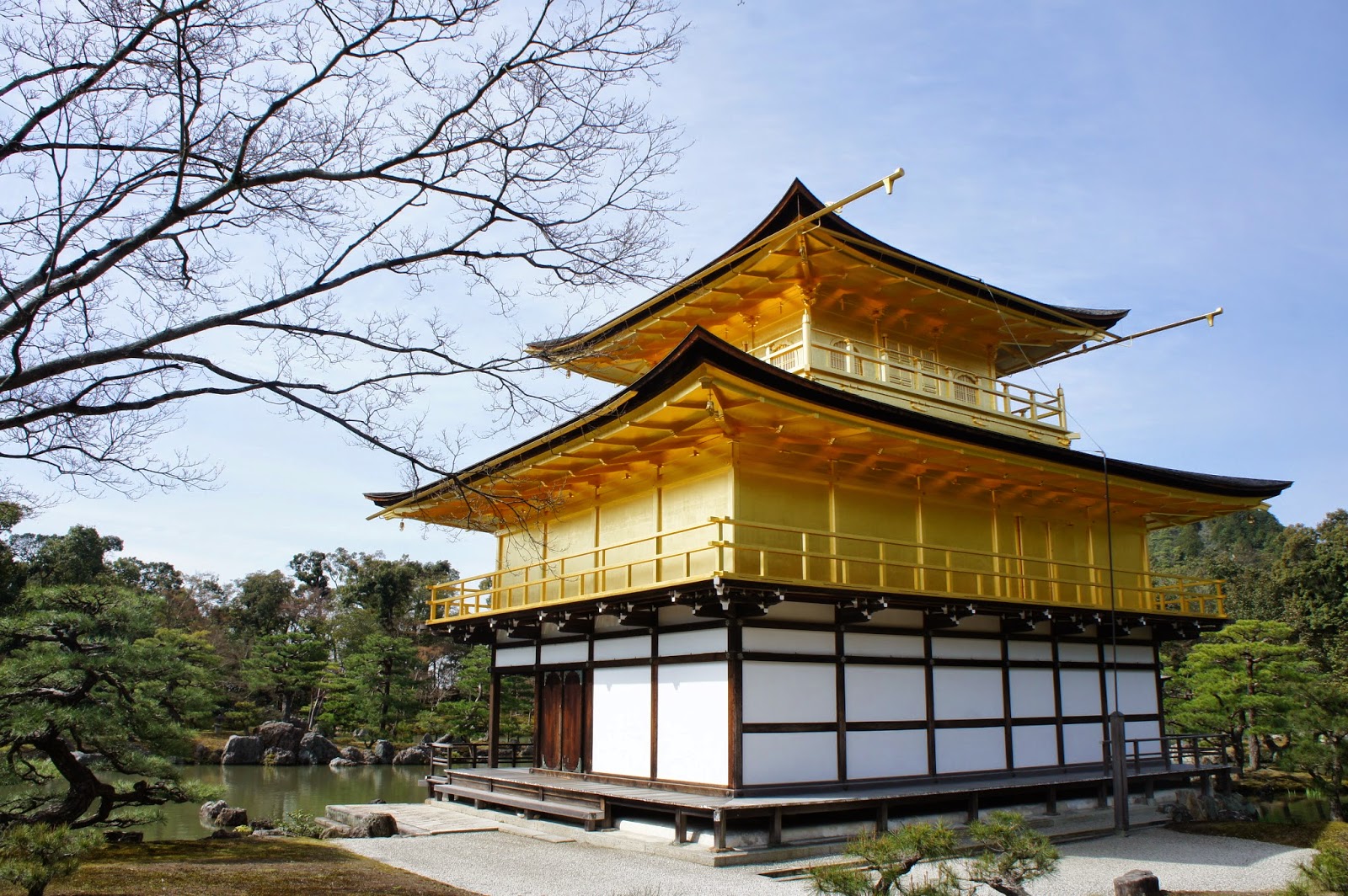
Kyoto's esteemed Kinkakuji (Golden Pavilion) and our esteemed clear pic of it *smug*
Following the path, we were taken behind Kinkakuji to its garden. I could imagine the retired Ashikaga shogun who built this building and garden sitting there, drinking tea, and enjoying his retirement. After his passing away, the building was used as a temple. Kita juga mau deh pensiun tinggal di rumah emas hihihi!

Kinkakuji's golden butt, sexy eh?
Garden and pond behind Kinkakuji
I LOOOVE seeing ema (wooden wishing plates)  PS: I know, my hair was a mess but I deliberately make it grow long during pregnancy!
Omikuji vending machine!
I considered Kinkakuji small, it only took us 30-40 minutes to get around. Uhh balikin duit gue! My hubby and I decided to see another temple nearby. There were many other temples near Kinkakuji (Ninnaji, Ryoanji, Daitokuji, and many smaller temples) but we decided just to see Ninnaji. Why? Because we don't want to spend too much time and money hehe... Ninnaji is interesting since it's said to have beautiful sakura trees. Ryoanji is also very famous for its zen garden but we were more interested in sakura. Both are UNESCO world heritage sites and reachable by walking for about 30 minutes from Kinkakuji.
The road to Ninnaji from Kinkakuji, very peaceful

It turned out that Ninnaji is HUUUGE! 

 map
Entrance fee to Ninnaji was free (except during sakura blooming season; visitors had to pay JPY 500) but visitors had to pay JPY 500 to go into Goten area all year long. We already paid for entrance fee to Ninnaji so we decided that we didn't have to go inside Goten (which I read somewhere is more beautiful in autumn and has no sakura trees).

We entered from its parking lot (Higashimon Gate) at east side (thank goodness there was a restroom there!) then walked around the southeastern area and got out from Niomon Gate at south side.
Sakura blooms near Ninnaji's Higashimon Gate


Cantik kaann (sakuranya)?
Buddha Statue
Kondo (or Miedo? duhh maap lupaa)
Bell fry (designed as such the bell couldn't be seen from outside)

36-meters-high five-storied pagoda
Ninnaji has a famous garden of Omuro Sakura, a type of sakura that blooms later than general sakura (in mid April to beginning of May). If you visit Kyoto during that period, you can still seek for sakura blossoms at Ninnaji! There were about 200 trees in Ninnaji precinct. They had distinct features of short stature and low branches that seemed like they sprout from the ground. Despite of its being small and short, they were already there since early of Edo period!
Omuro sakura trees, the late bloomer
They were still bare when we came at the beginning of April
I really love the history of Ninnaji. Its construction was started on the second year of Ninna (886) to fulfill an emperor's wish and finished 2 years later (after the emperor passed away). The next emperor became Ninnaji's head priest after he abdicated and he built a residence in the precinct that was called Omuro (that's why its sakura trees were called in the same manner). Many of his successors also became head priests there for generation; that makes Ninnaji the highest ranked monzeki temple in Japan. Monzeki is Japanese Buddhist priests from aristocratic or even imperial backgrounds.

Both Ninnaji and Candi Borobudur in Indonesia were Buddhist but very different in architectural styles, which were very much influenced by their respective cultures. Ninnaji was about 60 years younger than Candi Borobudur (which was built in about half a century) but it's a shame that none of its original buildings from the 9th century survived. 

Ninnaji had been burnt down several times during many feodal wars. Its reconstruction was funded by many famous samurai, including famed fiery daimyo Oda Nobunaga and the Tokugawa third shogun Iemitsu. Many of its building also built from materials of other imperial buildings, such as Kondo (main hall) was an alteration of Shishinden (coronation hall of the Imperial palace) and Miedo (founder's hall, used to keep the bodies of its former priests) was built using materials of Seiryoden (Imperial Palace pavillion). In 1887, the buildings of goten were burnt down and rebuilt about two decades later, which could be seen as they were now.

Okay. I need to stop ranting about history here. (^^)

Niomon Gate seen from outside of Ninnaji complex
By the time we got out of Ninnaji, I was already in terrible mood due to (pregnancy) hunger. I could eat my hubby right there! Perhaps he was afraid to be bitten too so he hurriedly took me to find lunch (or rather, late breakfast). I was already pretty devastated (seriously) when we didn't find any interesting food stalls or resto on our way to big road (we planned to meet our friends at Kyoto Station). But an angel came out of nowhere! A lady stopped us at the pedestrian and asked us to stop by at her curry shop. The menu was hand-made! We followed her to her nearby shop; it was very small but empty. We guessed that the cook was her husband and she acted as waitress. There was a pretty little girl sat nicely at the bar table (perhaps their daughter). I couldn't find their shop's name in the menu but when I checked 4sq, it was Family Kitchen! Very suitable!

Hand-written menu

My Indian chicken curry (front) and hubby's hot keemd curry (back)
And we experienced the most delicious curry in our lives! They were served with fresh rocket salad. I wanted to steal their vinaigrette recipe! We left happily with full tummy and praised the cook a lot.

We took bus from Kinkakuji Mae (Kinkakuji Road) to Kyoto Station and met our friends there. In Kyoto, most prominent city transportation mode is bus, with flat rate JPY 230. You can learn more about it here. But we must be ready when buses are slow due to traffic or packed (e.g. at Gion). We can use trains and subways too but their routes are more limited.

We took the chance to buy Starbucks Kyoto tumbler, which was widely known as one of the prettiest Starbucks city tumblers. As usual, we'd get a free beverage for purchasing a tumbler so we chose lemon vanilla frappuccino which was only available in Japan; it was very sweet. Hmmm, exactly what we needed, a full-calorie drink when we climbed Fushimi Inari's lairs that afternon.
Pretty, eh?
We also bought Kyoto One-Day Bus Cards (JPY 500 each) at Kyoto Bus Information Center in front of Kyoto Station. 
- The ticket was empty and could be used that day, or the next day, or even the next week. 
- However, the ticket only valid in the same calendar day since its first usage.
- Unlimited use in central Kyoto and Arashiyama.
- It can be bought from bus drivers but there is a risk that they run out of cards so we chose to buy it from Info Center.
- It's most useful if the user uses buses 3 times a day or more.
We bought 2 tickets for each person to be used on our next days in Kyoto.

There are also other one-day passes available, you can learn about them here.

We took JR Nara line train (5 minutes, JPY 140 one way) and walked for 5 minutes to Fushimi Inari Taisha. Entrance fee is free (yipeee, biasalah maniak gratisan). I read about this place a lot in mangas so I was very excited!
A not-so-talented photographer took our pic, gemez ahh itu torii-nya kepotoong!
*lirik tajam Rudy*

As mentioned so many times in mangas, this is the biggest Shinto shrine dedicated to Inari, the god of rice. Inari's messenger is fox (kitsune) so there were many fox statues around the shrine. I imagine them suddenly came alive and talked to us (which we won't understand at all coz they spoke in Japanese). The entrance gate was called Romon and donated by 'the monkey' shogun, Toyotomi Hideyoshi.
Waiting for Kitsune-san to move, LOL

Inside the shrine compound
Torii ema, very vibrant and beautiful! Must be hard to write on them.
Kitsune ema. It came blank so the wishers can use their creativity to draw faces on them. Creepy and funny!

Behind the shrine compound, there was a hiking trail to the top of the hill which became so famous for its Senbon Torii (thousands of gates). They were donated by individuals, families, and corporations; we could see their names and date of donations behind each torii. The smallest torii costs about JPY 175,000 and a large one can cost more than JPY 1 million!
 
The inscriptions behind those torii were beautiful!

There were many tourists trying to get good spot to take pics. Better use your time to walk ahead of them (there are usually smaller pic-taking crowds ahead) rather than to wait for them to leave. It took 2-3 hours to reach the summit and I had no stamina to do that. It was getting dark too so my hubby and I got back to the shrine while our friends continued their hike. We tried some snacks while we waited them to come back.

Didn't buy the ice cream, though, due to the cold weather. But people still queue for it!

Oishii! The tako inside it was big!

Yakitori. Quite expensive but smelled so good! A bit tough too.
Our friends took a very long time to come back (and had no internet access so we couldn't contact them). We worried and almost asked an officer before they finally appeared, exhausted and hungry. Yep, they were lost. They also bought some snacks before we headed back to the city to have dinner.

I forgot to mention, the restrooms at the shrine was A MESS! Very disgusting, smelly, full of trashes. Some tourists didn't even flush! Urrgghhh! It was not possible for me to use it. I blame the Chinese tourists. There were many of them that day. Yes, I generalize, but many Chinese people still do that and be very unhygienic in this modern day. You make me ashamed, people with same ancestors! I had to wait until we reached the station to do my business. 

We got back to Kyoto Station and continued our journey by bus to Gion. It was 7 PM and Gion was very crowded, but the sakura trees were beautiful. I didn't take many pics because I was already very hungry (again).
We entered a ramen shop and ate there. It was so-so, not suitable to our taste. We said goodbye to our friends and got back to our rented room to get some rest.